
Artificial intelligence can analyze the information available to it very quickly. But a seemingly coherent recommendation can become inappropriate if a decisive piece of data is missing or if the patient’s situation has changed since it was last recorded.
A perspective on clinical continuity, accountability, and patient-controlled information sharing.
Medicine rarely unfolds within a single institution, a single professional relationship, or a stable patient situation. Yet an AI system may be asked to interpret the fragments it can access as though they represented the whole.
The result can be more dangerous than an obvious gap. A coherent-looking medical record may conceal events that occurred elsewhere, decisions made by other clinicians, and changes in the patient’s circumstances. If those omissions are not visible, neither the clinician nor the AI system necessarily knows what to question.
Artificial intelligence is accelerating clinical decision-making faster than health systems are improving their ability to preserve the context of those decisions.
Important clinical information is not always found in an electronic record. It may be known to the patient, an authorized family member or a professional consulted elsewhere. Sometimes the right approach is to identify the gap, ask a relevant question and bring the answer into clinical reasoning.
Authorized professionals can maintain secure exchanges with patients, ask follow-up questions and receive attributable, time-stamped responses.
An AI system could flag uncertainty or suggest a targeted question, sent according to rules of authority, consent, validation and clinical oversight. This automated mechanism is not presented as a stand-alone feature that is already commercially available.
Gap detected → Authorized question → Documented response → Human reassessment
A patient receives a prescription at one clinic. A few weeks later, another professional changes it after an adverse effect. This change is not passed on to the first clinic. If an AI assistant analyzes only the original record, its recommendation may be consistent with the old data but unsuited to the current situation.
The problem is not only missing information: it is that no one necessarily knows it is missing. Targeted recontact with the patient can bring this change to light before the professional confirms their decision.
Hypothetical example for explaining the information problem; not a statement about a particular AI product, patient, or medical recommendation.
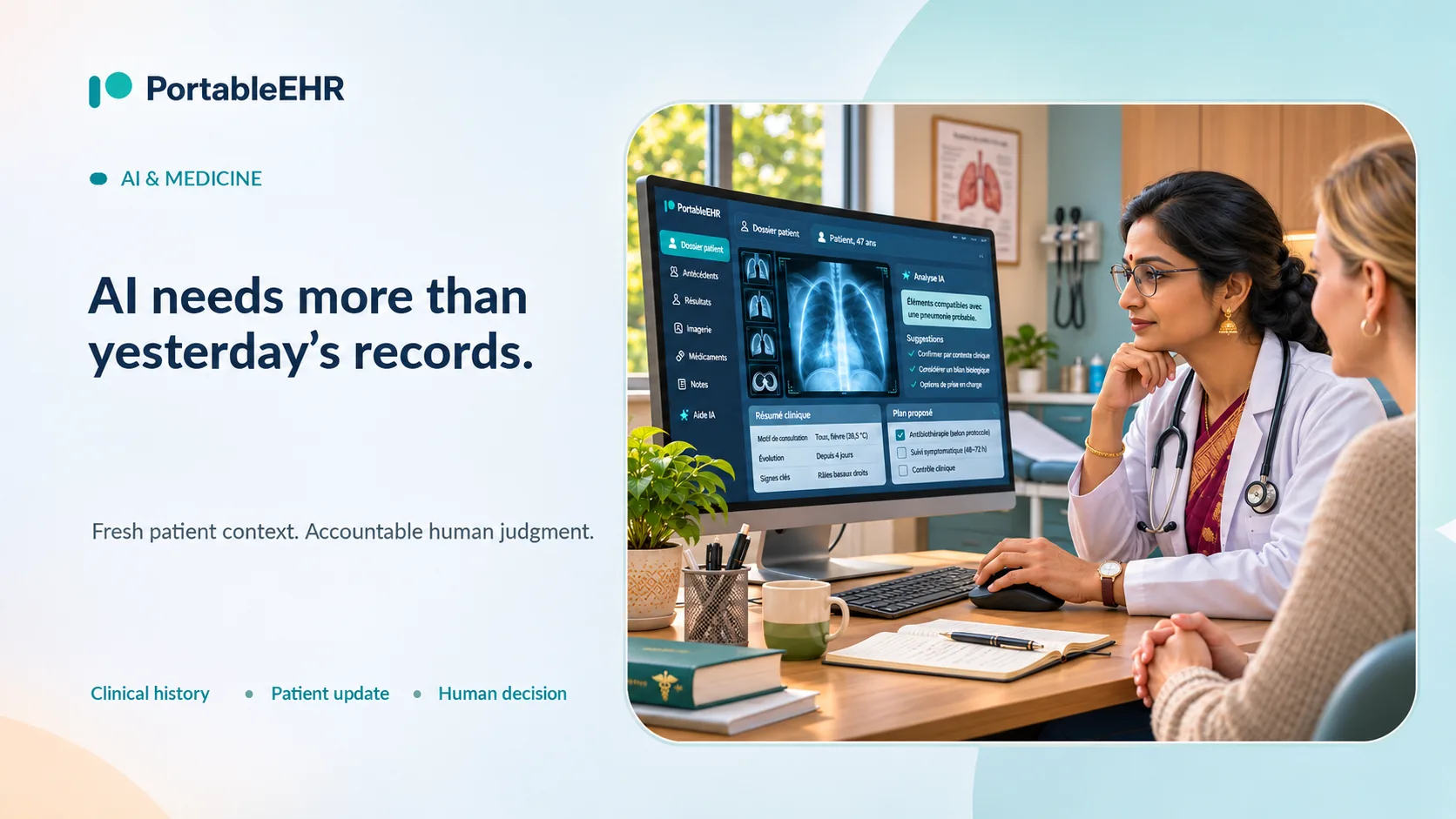
Existing data + new information + accountable clinical judgment.
Multiple professionals, multiple facilities, modified treatments and uncommunicated events can produce a fragmented medical history. A reliable analysis must consider where data came from, when it was recorded, its limits and the possibility that something new changes the conclusion.
01
A patient may see several primary care physicians, specialists in the same discipline, or covering clinicians over time. Each may make reasonable decisions based on a different subset of the patient’s history.
What may be missing: prior concerns, rejected hypotheses, medication changes, unresolved questions, or reasons another clinician chose a different course.
02
Clinics, hospitals, diagnostic centers, and independent practices may deliver care sequentially without exchanging the relevant information. Institutional boundaries and commercial competition do not disappear simply because the patient moves between them.
What may be missing: investigations, treatments, adverse events, clinical discussions, and follow-up plans held in another organization’s systems.
03
Patients may stop taking a medication, change their dosage, seek treatment elsewhere, use over-the-counter products, miss follow-up, or experience new social and functional constraints. These changes can materially alter the significance of earlier information.
What may be missing: the reason a treatment was not followed, a new exposure, a change in adherence, or a developing problem that was never communicated or recorded.
04
A recommendation may be internally consistent with the information presented and still be inappropriate because the patient’s context has changed. Faster processing does not compensate for an absent fact that would have changed the decision.
What may be missing: a decisive contraindication, a new diagnosis, a revised preference, a recent test, or a previously documented concern that was not shared.
An AI-generated answer can appear comprehensive even when the underlying data are incomplete. The system may not be able to recognize that a relevant event, conversation, or change is absent from its inputs.
That creates a particularly consequential clinical blind spot: the assumption that everything needed for a decision has already been considered. A rapidly produced recommendation can accelerate action, reinforce unjustified confidence, and reduce the opportunity to discover missing context before treatment begins.
Information dispersed or undocumented
Absence is not recognized
Apparent completeness
When action outruns verification
This is a risk mechanism, not a claim that every AI system behaves this way or that human clinicians are immune to the same failure. The practical concern is the scale and speed at which incompletely grounded decisions could be produced and acted upon.
Clinical continuity depends on more than transferring a final note. It can require identifying the participants, the sequence of exchanges, what information was available at different points, what was asked or reported, and what permissions govern subsequent access.
Understand when observations, questions, responses, and changes occurred across an episode of care.
Know who communicated information, and distinguish recorded facts from assumptions or later interpretations.
Respect granular sharing choices and revocation, even when an earlier participant previously had access.
No platform can reconstruct undocumented events or guarantee a complete record of a patient’s changing circumstances. Preserving documented context reduces avoidable losses; it does not eliminate clinical uncertainty.
No AI system should be the sole authority responsible for generating, validating, and investigating its own conclusions. Healthcare organizations need the ability to examine decisions and investigate unexpected behavior independently of any single AI provider.
A second AI is not necessarily a truly independent check if it analyzes the same incomplete data as the first. It may reproduce the same errors or confirm a conclusion based on outdated context. Meaningful verification must also be able to question the initial assumptions, look for missing information and, where appropriate, allow an authorized professional to recontact the patient to update the clinical context.
Independent verification is not a rejection of AI. It is a prerequisite for accountable AI.
Incidents in other areas of AI use have also shown the importance of keeping oversight and investigation mechanisms that are independent of the systems being assessed. In medicine, this independence must also cover the quality, provenance and timeliness of the information used to support a clinical decision.
Further reading: OpenAI incident account. The incident is a cybersecurity example, not a clinical event.
Provenance, recency, consent and missing information
Other sources, alternative models and auditable investigation
Clinical judgment, documented rationale and oversight
PortableEHR’s potential role is in the independent identity, consent, communication and traceability layer—not in providing model cybersecurity testing, autonomous diagnosis or a multi-model verification engine.
PortableEHR is not an AI diagnostic engine. It provides infrastructure for identity, authority, consent, two-way communication and traceability. Where it is deployed, this infrastructure helps authorized people recontact each other and document exchanges that can shed light on the clinical context.
We should not confuse the ability to generate a clinical recommendation with the ability to justify a clinical decision.
Better-documented clinical context · Independent verification of hypotheses · Decisions under human responsibility
Note: An authenticated response can be attributed to a person; this guarantees neither its medical accuracy nor the completeness of the context. Interpretation and decision-making remain the professional’s responsibility.
Clinical AI deployment should ask not only what a model can conclude from available information, but also what sources were consulted, what might be missing, how current the information is, and which decisions require independent verification.
Structured communication and traceable context can support that discipline. Any future use of InTouch context by clinical or research AI—including targeted recontact—would require appropriate integrations, purpose-specific permissions, consent and access controls, validation, and clinical or research oversight. Availability of a communication history does not itself establish its completeness or fitness for a particular clinical decision.
Explore how patient-controlled communication and clinical continuity could strengthen your organization’s workflows—and inform a responsible approach to AI in medicine.
PortableEHR supports clinical communication and documented context. It does not replace professional judgment or provide an autonomous clinical decision service.